
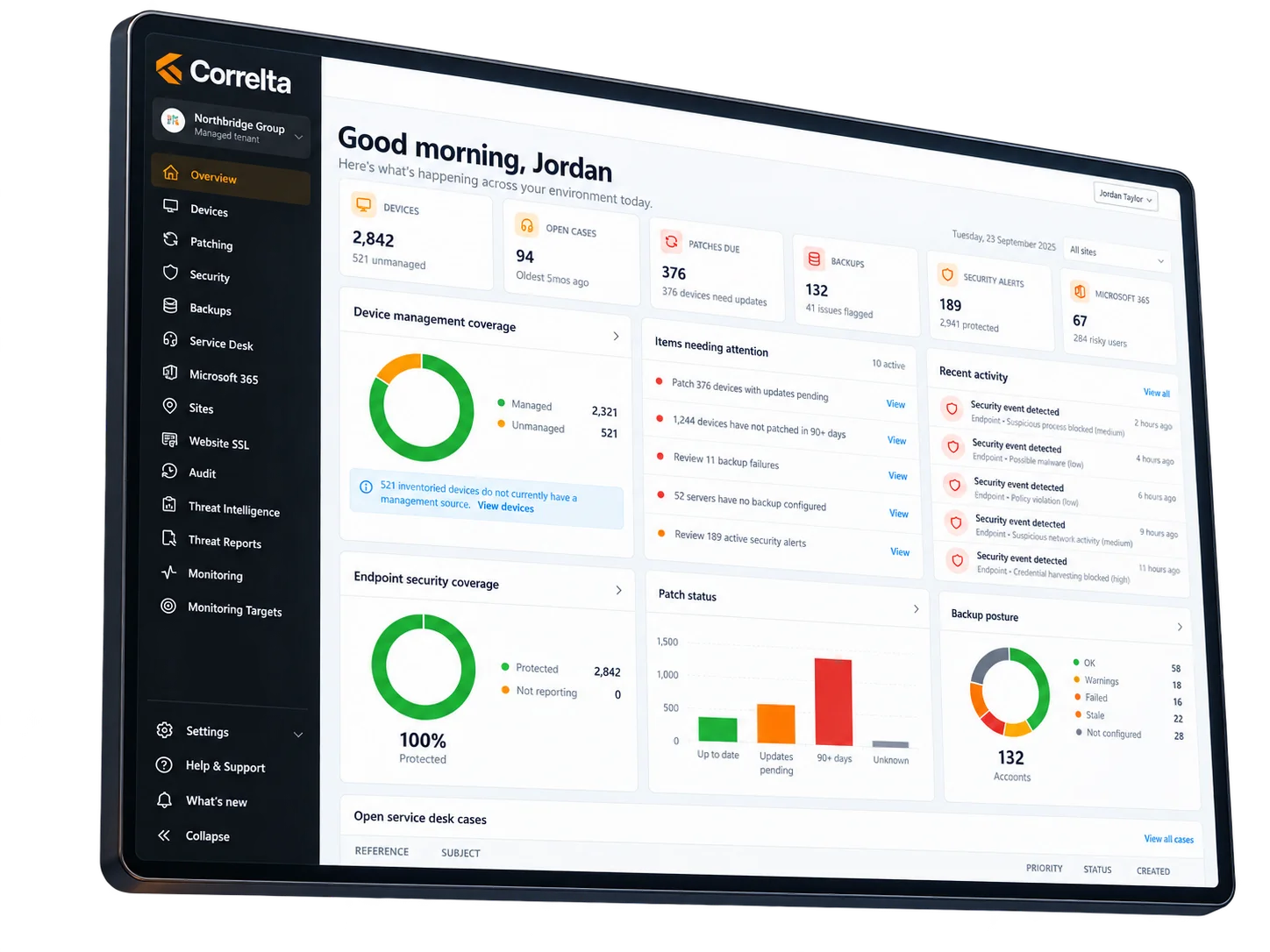
Devices & Estate
Find the device you are responsible for, its user, location, operating system, hardware, storage, software, security and update context without piecing the asset story together from separate inventories.
Use the modules that matter to you. Each one answers a different operational question. Together they help your team spot exposure, protect services, explain what changed and decide what needs attention next.
A user problem can be an identity problem. A device problem can be a patching or security problem. A site issue can be monitoring, website or support. Correlta keeps those questions close enough together that your team can follow the problem instead of the product menu.
A trustworthy estate is the starting point for every patch, security, support and investment decision that follows.
Find the device you are responsible for, its user, location, operating system, hardware, storage, software, security and update context without piecing the asset story together from separate inventories.
See the people behind the estate, their account state, activity, licences, linked devices and identity attention so orphaned access and weak protection are easier to spot.
Bring devices, monitoring, website, backup and site context together so you can tell whether a problem belongs to one machine, one location or something wider.
Find enabled and inactive accounts, MFA and risk signals where available, managed-device attention and licence context without treating Microsoft 365 as a separate island.
The value is knowing what deserves attention first, what is affected and what should happen next.
See overdue devices, missing critical updates, reboot requirements and stale patch evidence so the team can start with the machines carrying the clearest exposure.
See which endpoints need investigation, which alerts are critical, where protection is weak and which device or owner is affected before security noise becomes background wallpaper.
Find public links, external recipients, edit access, no-expiry shares and the owners behind them so external sharing can be reviewed deliberately instead of discovered by accident.
Move from a long findings list to the affected systems, severity, follow-up and reporting evidence that helps the team decide what to remediate first.
Resilience is easier to manage when the warning arrives before the escalation.
See backup health, protection context and history clearly enough to follow up on warning signs while there is still time to correct them.
See current availability, latency, incidents and site-side monitoring context so you can tell whether a problem is local, wider or simply missing fresh evidence.
Keep website reachability, certificate expiry and actionable findings on the same radar as the rest of the environment instead of waiting for a customer-facing failure.
Support work becomes more useful when current demand, priority, history and evidence can be followed without rebuilding the service story each time.
Follow the ticket story from request through comments, dates, ownership and linked context so triage and handover start with fewer missing pieces.
Understand demand, outstanding work, response and resolution performance, service risk and meaningful trends without creating a separate spreadsheet version of the truth.
Keep significant changes and supporting evidence available when an engineer, customer, auditor or leader needs the story behind a decision.
Show what has shipped, what is being worked on and where customer votes matter, with product progress visible between update emails and meetings.
The real value appears when you can move from the issue to the affected person, site, patch state, security position, monitoring result or support case without starting the investigation again.
Show us one of your real questions →
Tell us where your team loses time, gets surprised or struggles to prove the answer. We will show you the smallest useful Correlta starting point.